- Aug 1, 2024
Are you the Ideal Team Player? Part 1, Humility
- Richard Foulis
- 0 comments
In a series of posts we are going to explore The Ideal Team Player model. Today we are looking at the virtue of Humility.
For those organisations that are deeply committed to embedding teamwork into the fabric of their culture, it becomes clear that the right people are not just those who excel in their roles but are those who share three fundamental virtues: humility, hunger, and people smarts.
These virtues are chosen deliberately, with the term 'virtue' itself being a thoughtful selection. The word 'virtue' not only denotes quality and asset but also carries with it connotations of integrity and moral excellence. Of these virtues, humility stands out as paramount, embodying the essence of virtue in its truest form. Meanwhile, hunger and people smarts, though primarily categorised as qualities or assets, are integral in their own right, making the collective terminology of 'virtue' the most fitting descriptor. This concept, while simple in theory, is revolutionary in its application, offering a blueprint for building and sustaining a team that is not just competent, but harmoniously aligned with the company's vision and values. By focusing on these virtues, organisations can ensure that they are not just filling positions, but are strategically placing the right individuals in the right seats—those who will drive the company forward with their skills, dedication, and moral compass.
How it all started
The Author and Creator of The Ideal Team Player
For more than twenty-five years, Patrick Lencioni has been working with teams to help them become more cohesive, effective and successful. In 1997, he founded the Table Group, a firm dedicated to making organisations healthier and work more dignifying. He has written 13 best-selling business books on the topics of teamwork, leadership and culture (including The Five Dysfunctions of a Team, The Advantage, and The Ideal Team Player).
When Pat started his consulting firm he established the core values of humble, hungry and smart. These principles had guided him well in his previous roles so it was natural to establish these for his new company. Often, clients would inquire about the values of The Table Group and once revealed, these core values and hiring criteria resonated strongly and regularly. They determined that these words (humble, hungry and smart) weren't necessarily core values, instead, they were critical hiring and developmental criteria for any organisation that valued teamwork. From here the model was born.
The Inside Track has completed Certification Training offered through the Table Group and as such, has been equipped with the tools and resources to help leverage the various models with individuals, teams and organisations.
About the Virtues
The virtues of being humble, hungry, and smart are indeed self-evident; their importance is clear and universally acknowledged. Examining each virtue individually, one might hesitate to claim them as groundbreaking discoveries. However, the true power and uniqueness of these attributes lie not in their singularity but in their collective synergy. The absence of even one can disrupt team dynamics, making effective collaboration challenging, if not impossible. With this understanding, it's an opportune moment to delve into the development of the ideal team player model, where the interplay of humility, drive, and intelligence is not just preferred but essential for team success.
The Virtue of Humility
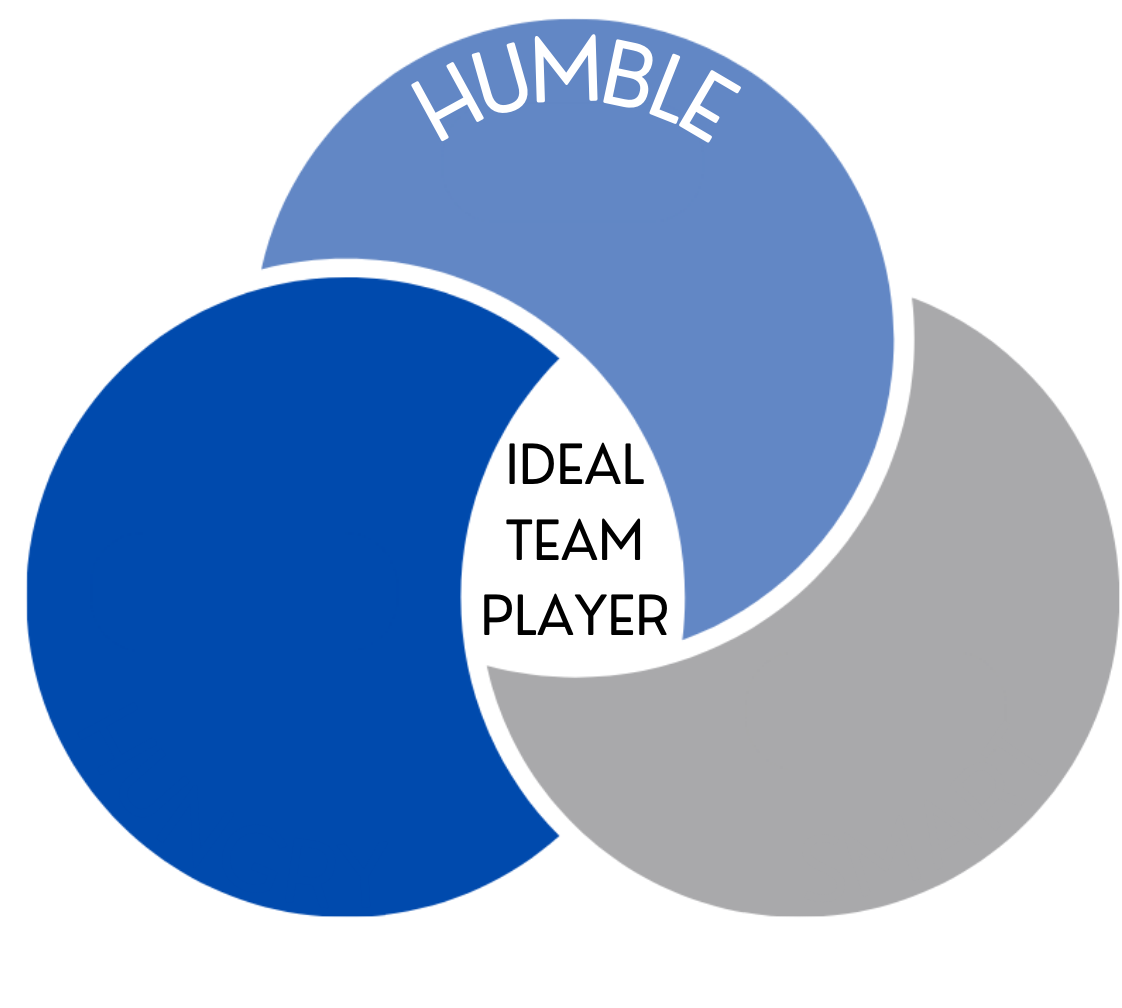
Within the framework of teamwork, humility is exactly as it appears. Exceptional team members are not burdened by an oversized ego or preoccupied with status. They readily acknowledge the contributions of their peers and are reluctant to draw attention to their own achievements. They distribute credit, prioritise the team above themselves, and perceive success as a shared endeavour rather than a personal triumph.
Given the critical role that humility plays in fostering team spirit, it's noteworthy that this trait stands as the most crucial quality for a team member to possess. Interestingly, despite the high value placed on teamwork, some leaders continue to accommodate individuals lacking humility. This is often justified by the unique skills these individuals bring to the table or overlooked due to their significant personal achievements, without adequately addressing the negative impact their arrogance may have on team dynamics. This issue is not confined to any single domain but is observed across various team-oriented environments, including sports and business sectors.
In the exploration of humility and its absence, it becomes essential to delineate two predominant types that exhibit a lack of this virtue, each with distinct manifestations and implications for group dynamics.
The first category encompasses individuals characterized by overt arrogance, who tend to center discussions and attention around themselves. Such behaviour is readily noticeable through their proclivity for boasting and seeking the limelight, which inherently undermines team cohesion by breeding resentment and fostering a divisive atmosphere. This archetype, often encountered in various professional environments, represents the quintessential ego-driven persona whose actions can significantly hinder collective efforts.
Conversely, the second group, while ostensibly less detrimental, presents an intriguing paradox. These individuals, despite their apparent generosity and positive demeanour towards others, suffer from a marked deficiency in self-confidence. This leads them to undervalue their own skills and contributions, inadvertently casting themselves as humble in the eyes of their peers. However, this misperception does not equate to genuine humility. True humility involves a balanced self-perception, acknowledging one’s abilities without exaggeration or diminishment. Hence, understanding the nuances between these two types is pivotal for fostering a truly collaborative and harmonious team environment.
An individual with a significantly diminished sense of self-esteem can inadvertently diminish team effectiveness by not promoting their own ideas or by overlooking to highlight observed issues. This form of modesty, while less noticeable than other, more overtly negative behaviours, still undermines the full potential of team performance.
Both of these personality types share a common factor: insecurity. Insecurity can lead some individuals to exhibit overconfidence, while it causes others to undervalue their own abilities. Although these behaviours vary in their impact on team dynamics, both can reduce overall performance.
Stay tuned for another blog post where we will explore the next virtue, that of "Hunger".